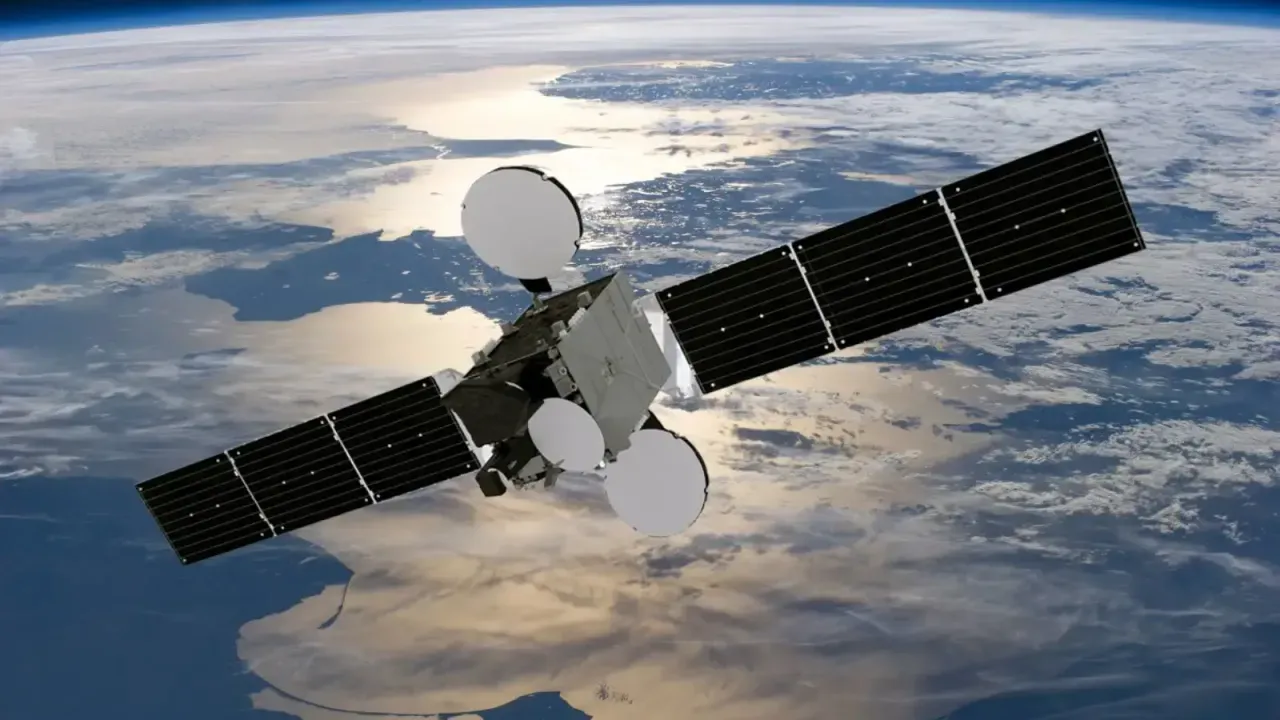
Türkiye on Dec. 15 marked the progress of Türksat 6A, the country’s first domestically built communications satellite, noting that the program began 11 years ago, with the project contract signed on Dec. 15, 2014, under the leadership of President Recep Tayyip Erdoğan.
Developed by Turkish engineers, Türksat 6A is seen as a milestone in Türkiye’s drive for independence in space technologies, placing the country among a limited group capable of designing and producing their own communications satellites.
About Türksat 6A
The “Türksat 6A Domestic Communications Satellite Development and Production” project was launched under the coordination of TÜBİTAK, in line with the operational needs of TÜRKSAT A.Ş. The program is jointly financed by the Ministry of Transport and Infrastructure, TÜRKSAT A.Ş., and TÜBİTAK.
The project aims to develop a geostationary (GEO) satellite platform domestically and establish the required national infrastructure, leveraging complementary capabilities across Türkiye’s industry and research institutes.
Industrial Roles and Development: Within the scope of the project, TUSAŞ was responsible for developing the satellite’s structural, thermal, and chemical propulsion subsystems, as well as mechanical ground support equipment and cabling design and production. In cooperation with TÜBİTAK Space, TUSAŞ also contributed to satellite data handling and command-control software, along with assembly, integration, and testing activities.
Assembly, integration, and testing were carried out at TUSAŞ’s Space Systems Integration and Test Center (USET).
Launch and Orbit: Türksat 6A was launched from Cape Canaveral, Florida, on July 9, 2024, and later placed into a circular geostationary orbit at an altitude of 35,786 kilometers.
Capabilities and Benefits: Equipped with more than 20 transponders across multiple frequency bands, Türksat 6A significantly increases Türkiye’s secure data communications capacity and provides critical strategic advantages.
Key specifications
-
Orbit: Geostationary (35,786 km)
-
Payload: 20+ transponders in multiple frequency bands
-
Mass: ~1,780 kg dry / ~4,220 kg launch mass
-
Mission Models Developed:
-
Thermal Structural Qualification Model
-
Electrical/Electronic Satellite Model
-
Engineering Model
-
Flight Model
-
Developed Equipment: Subsystems and equipment developed domestically for Türksat 6A include the flight computer, power distribution and regulation units, electric and chemical propulsion interface units, thermal control interface unit, reaction wheels and interfaces, fuel tanks and feed units, sun sensors, star trackers, and power processing and control units.
Officials say the project has also delivered lasting gains, including a national GEO satellite development infrastructure and a highly trained workforce, strengthening Türkiye’s long-term space and satellite capabilities.