


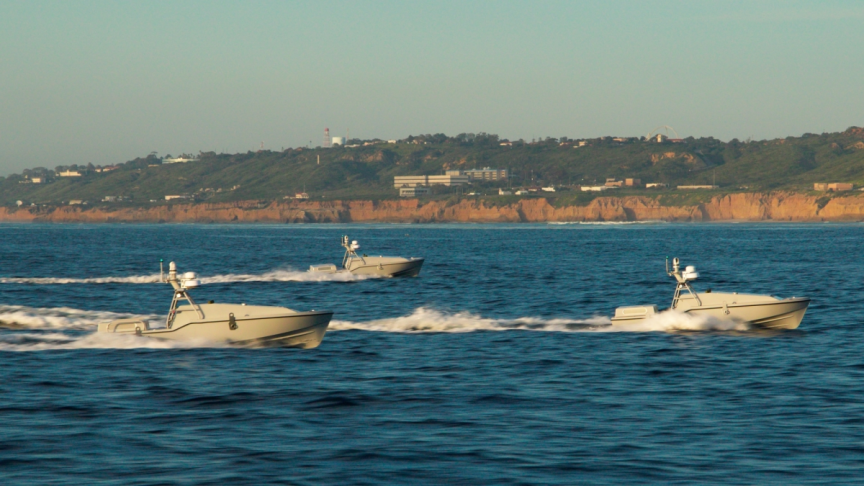
The U.S. military has confirmed that Saronic’s Corsair unmanned surface vessels (USVs) were used in the first-ever combat strike conducted by American sea drones, targeting a submarine and ship maintenance facility at Iran’s Bandar Abbas Naval Base.
In a social media statement, U.S. Central Command (CENTCOM) said three Corsair one-way attack USVs struck the facility, marking the first operational use of unmanned surface vessels by U.S. forces in a combat role.
Yesterday, using multiple one-way attack surface drones, CENTCOM forces successfully struck a submarine and ship maintenance facility in Iran. Three Corsair unmanned surface vessels hit the port at Bandar Abbas Naval Base, marking the first time American forces have employed sea… pic.twitter.com/bOM2kmgRxz
— U.S. Central Command (@CENTCOM) July 13, 2026
“Yesterday, using multiple one-way attack surface drones, CENTCOM forces successfully struck a submarine and ship maintenance facility in Iran,” the command said.
“Three Corsair unmanned surface vessels hit the port at Bandar Abbas Naval Base, marking the first time American forces have employed sea drones in combat operations.”
CENTCOM said the attack was intended to degrade Iran’s ability to threaten commercial shipping through the Strait of Hormuz, one of the world’s most strategically important maritime chokepoints.
Located on Iran’s southern coast, Bandar Abbas serves as a major headquarters for the Iranian Navy and has previously been targeted during the ongoing conflict.
The strike follows another milestone involving the Corsair platform. On June 8, a Corsair operated by the U.S. Navy’s Task Force 59 rescued two U.S. Army aviators after their AH-64 Apache helicopter crashed near Oman. That mission marked the first known personnel recovery by an unmanned military surface vessel, while the latest operation represents the platform’s first offensive combat use.
Built by Texas-based Saronic, the Corsair is approximately 7.3 meters long, can carry payloads of up to 453 kilograms, has a range of roughly 1,852 kilometers (1,000 nautical miles) and a top speed exceeding 35 knots (65 km/h). The vessel is designed for long-endurance autonomous operations and can operate individually or as part of a coordinated fleet supervised by a single operator.
The U.S. Navy awarded Saronic a $392 million production contract in December 2025, and Task Force 59 began deploying Corsair USVs in the Middle East in March 2026. Until now, the vessels had primarily been employed for surveillance, maritime security and support missions. Their use in the Bandar Abbas strike marks a significant expansion of the U.S. military’s operational employment of autonomous maritime systems.